
News - Behaviour in Crisis Lab
Join the Global Crises Project: An International Call for Collaborators
Behaviour in Crisis Lab at Jagiellonian University invites researchers from around the world to join the Global Crises Project, a large-scale international research initiative conducted in collaboration with the Centre for the Politics of Feelings at Royal Holloway, University of London, and affiliated with the Psychological Science Accelerator (PSA).
Researchers interested in participating are invited to submit an expression of interest by 31 October 2026.
Researchers interested in participating are invited to submit an expression of interest by 31 October 2026.
News:
media
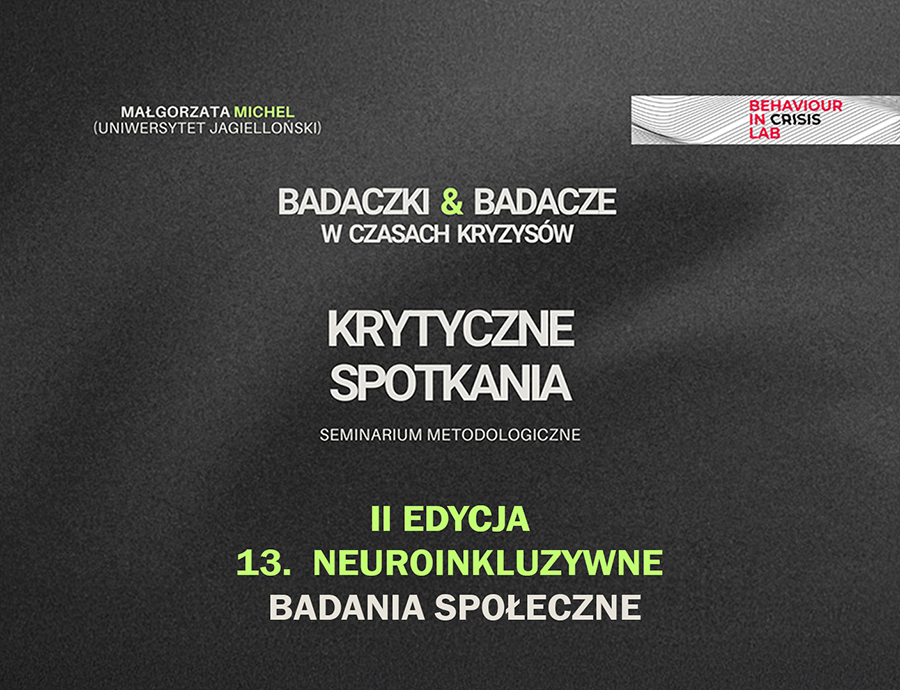
Seminarium metodologiczne online Badaczki i badacze w czasach kryzysów cz. 13, cykl II: Neuroinkluzywne badania społeczne
14.04.2026
Zapraszamy na kanał You Tube BiC Lab, na 13. spotkanie seminarium metodologicznego Badacze i Badaczki w czasach kryzysów. W kwietniu, obchodzonym jako Światowy Miesiąc Autyzmu, dr hab. Małgorzata Michel, prof. UJ, gości dr Dominikę Winogrodzką, socjolożkę i badaczkę społeczną z Instytutu Socjologii UJ, oraz Julię Kozakiewicz‑Domżał, kulturoznawczynię, edukatorkę i działaczkę społeczną związaną z ruchem neuroróżnorodności. Patronem cyklu jest Behaviour in Crisis Lab.
Read More o Seminarium metodologiczne online Badaczki i badacze w czasach kryzysów cz. 13, cykl II: Neuroinkluzywne badania społeczne

popularyzacja
publikacja
streszczenia
Empathy or Fear? What Really Shapes Our Attitudes Toward Refugees?
14.04.2026
Fear of war does not have to lead to withdrawal and hostility - it can also increase empathy and support for refugees. Higher levels of hostility toward migrants are shown by people who perceive them as a threat to culture and national identity. These concerns may be more important than economic or security issues, according to a study by researchers from the Behaviour in Crisis Lab at the Institute of Psychology of Jagiellonian University.
Read More o Empathy or Fear? What Really Shapes Our Attitudes Toward Refugees?

aktualności
publikacja
Can Identical Data Lead to Different Conclusions? A Paper Co‑Authored by a Researcher from the Behaviour in Crisis Lab
09.04.2026
Are the results of scientific research really as clear‑cut and objective as is often assumed? The latest findings, published in the article „Investigating the replicability of the social and behavioural sciences” in Nature, show that final conclusions can depend to a large extent on subjective decisions made by researchers at successive stages of data analysis. One of the co‑authors of the publication is Dr Ewa Szumowska from the Behaviour in Crisis Lab at the Institute of Psychology, Jagiellonian University.
Read More o Can Identical Data Lead to Different Conclusions? A Paper Co‑Authored by a Researcher from the Behaviour in Crisis Lab

aktualności
wywiad
Sometimes one phone call can save a child’s life
09.04.2026
Why is responding to violence against children and young people so important, and what can systemic solutions change? In an interview conducted by Katarzyna Pawlicka and published in the latest issue of Alma Mater, Dr hab. Małgorzata Michel, Professor at Jagiellonian University (UJ), talks about aggression, violence, and effective forms of support. She is the Chair of the Team for Standards of Ethics in Social Research Involving Children at the Office of the Ombudsman for Children and the leader of the thematic group Behaviour in Crisis Lab, which focuses on issues affecting young people in crisis.
Read More o Sometimes one phone call can save a child’s life
meetings
wydarzenia
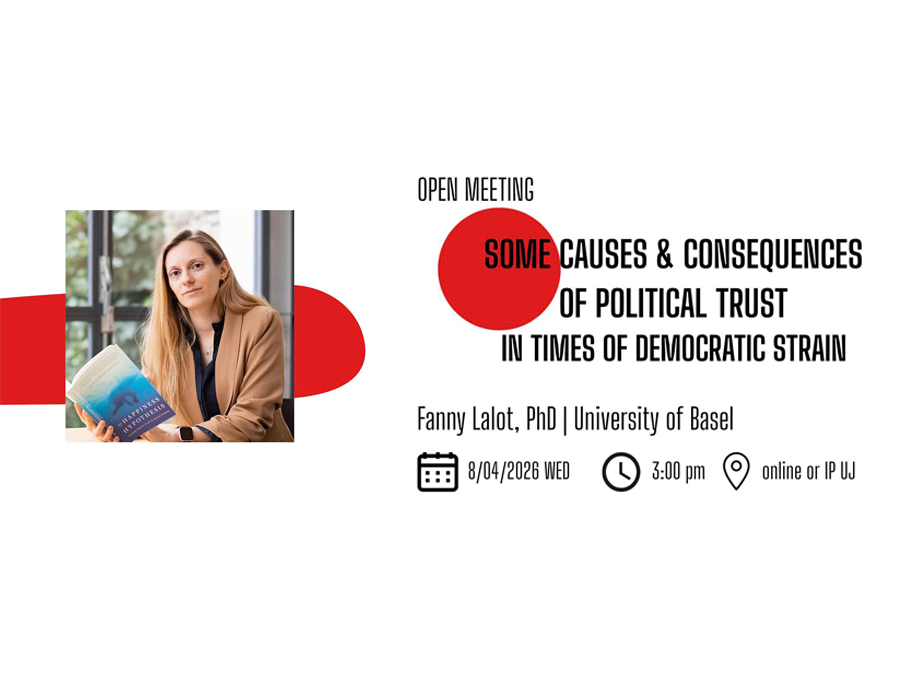
BiC Lab open meeting: Some causes and consequences of political trust in times of democratic strain
07.04.2026
We invite you to the weekly open Behaviour in Crisis Lab meeting. The speaker at the upcoming meeting will be Dr Fanny Lalot, a social psychologist from the University of Basel, whose research focuses on trust and cooperation in social relationships, prosocial behaviour, as well as attitudes toward the natural environment. In her talk, “Some causes and consequences of political trust in times of democratic strain”, Dr Lalot will present the latest findings from her research team examining the causes and consequences of political trust during periods of democratic strain.
Read More o BiC Lab open meeting: Some causes and consequences of political trust in times of democratic strain